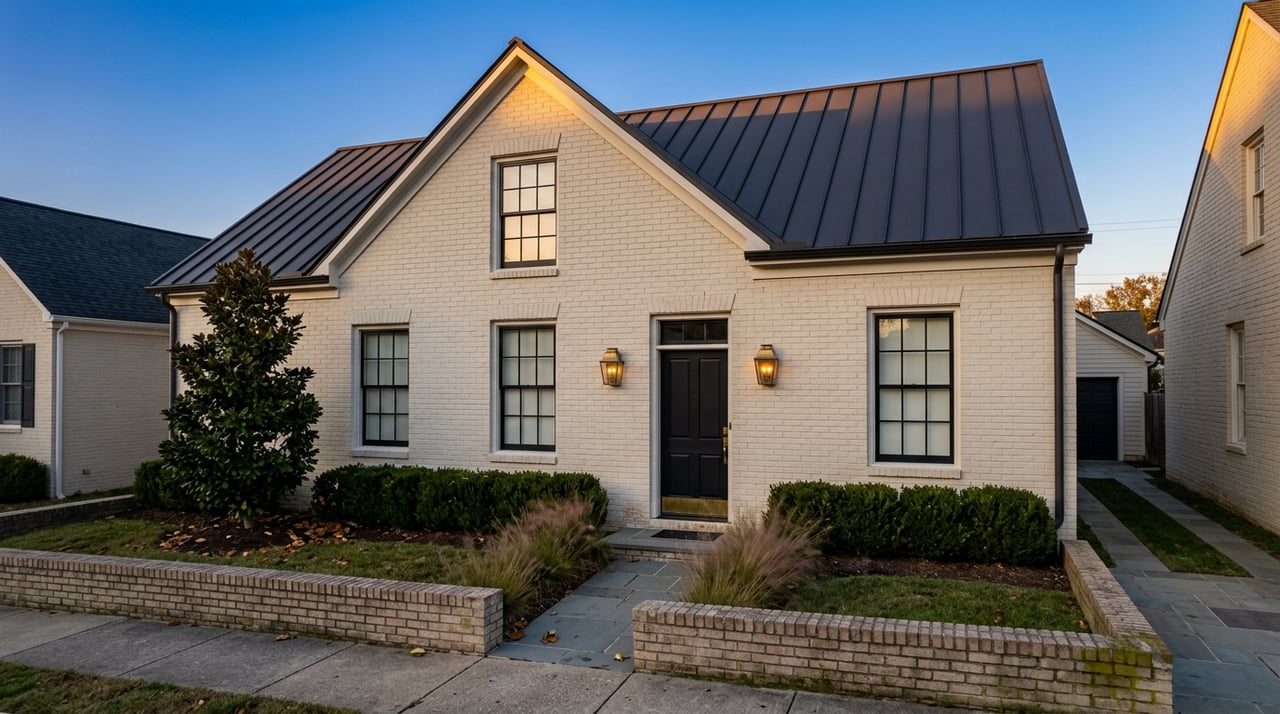
Things to Do in Edgehill Village, Nashville, and Nearby
September 24, 2026
September 24, 2026
There's no sign on the door. You find Old Glory by walking to the corner of Edgehill Avenue and Villa Place, spotting the unmarked entrance tucked into what looks like the back of a retail strip, and trusting that the golden light spilling from underground means you're in the right place. Descend the spiral stairs and you're standing in a former boiler room, coal hopper still hanging overhead, electrical boxes from the 1920s still bolted to the brick. It has been this way since the bar opened inside the shell of White Way Cleaners, once one of the largest steam laundries in Nashville. Nobody who already lives in Edgehill needs directions. The lack of signage is the point.
That contradiction, a neighborhood landmark that refuses to identify itself, turns out to be a decent way into a larger fact about how Edgehill actually functions. This is a small district. Its entire commercial and recreational identity runs through two properties that sit a few blocks apart, and in April 2025, one of them changed hands for eight figures while the other quietly kept doing what it's done since a university paid to renovate it more than a decade ago. The ownership shuffled. The rhythm didn't.
Old Glory occupies a corner of Edgehill Village, the retail and restaurant complex at 1200, 1201, 1207 and 1209 Villa Place that was originally built between 1920 and 1934 and renovated into its current form in 2016. The whole property spans 2.41 acres and roughly 58,468 square feet. In April 2025, JLL Capital Markets closed the sale of that footprint for $50 million on behalf of Asana Partners, the Charlotte-based firm that had owned it. That works out to almost $20.7 million per acre for a stretch of Nashville real estate you could walk end to end in about three minutes.
What that sale actually changed for the people who live around it is smaller than the price tag suggests. The tenant list at Edgehill Village mostly stayed put. Barcelona Wine Bar is still pouring tapas and Spanish wine. Sadie's is still running its Mediterranean mezze menu on the patio that anchors the busiest stretch of storefronts. Bella Napoli is still turning out Neapolitan pizza. Egghill, the counter-service breakfast spot that built its business on quick, high-quality food for Music Row staff and Belmont and Vanderbilt students, is still open for the same narrow morning-into-early-afternoon window it always has been.
Two more recent arrivals at the Village were Van Leeuwen Ice Cream and Framebridge, both opening their first Tennessee locations inside the Village. Neither of those businesses required anyone to change how they use the neighborhood. They just gave people one more reason to already be there.
Two blocks from that $50 million transaction sits E.S. Rose Park, a 24-acre public athletic complex on what was once Civil War battleground land, at the corner of Edgehill Avenue. Nobody sold this parcel recently, because nobody could. Metro Parks and Recreation owns and schedules it, and it stays open to the public from dawn to dusk except when a game or practice has it reserved.
The park's more interesting number isn't its size. It's what it cost to bring it up to its current standard. Belmont University invested more than $9 million between 2010 and 2011 to renovate the fields to NCAA Division I specifications, since Belmont's baseball, softball, soccer and track teams use the space alongside Metro schools and the surrounding neighborhood. That $9 million bought a walking track, baseball and softball diamonds, soccer fields, basketball courts and a new playground, spread across 24 acres, which comes out to roughly $375,000 per acre invested.
Set those two numbers side by side and the shape of Edgehill gets easier to see. The private, 2.41-acre commercial parcel just traded for about $20.7 million an acre. The public, 24-acre recreation parcel was built up for about $375,000 an acre, funded by a university rather than a buyer looking for a return. The private parcel's sale price per acre was roughly fifty-five times the park's renovation investment per acre. Both sit within a few minutes' walk of each other, but those figures compare a sale price with renovation spending, not the value of the land itself.
Here's how those two properties compare on paper:
| Edgehill Village | E.S. Rose Park | |
|---|---|---|
| Size | 2.41 acres | 24 acres |
| Ownership | Private (sold for $50M, April 2025) | Public (Metro Parks and Recreation) |
| Recent investment | $50 million acquisition | $9 million renovation (2010–2011) |
| Per-acre sale price/renovation spending | Roughly $20.7 million | Roughly $375,000 |
| Access | Retail hours, tenant by tenant | Dawn to dusk, public |
| Anchor tenant/feature | Old Glory, Sadie's, Barcelona Wine Bar | Walking track, ball fields, basketball courts |
Rose Park also carries a piece of history that outlasts any renovation figure. It's named for the Reverend E.S. Rose, who led Greater Bethel African Methodist Episcopal Church, founded in 1866, and who was a Nashville community activist during his tenure from 1928 to 1944. Belmont dedicated a plaque there in 2020 honoring Nashvillians tied to the Negro Leagues, a marker that has nothing to do with square footage or acquisition costs and everything to do with why the park matters as a gathering place independent of what it's worth.
None of this shows up in how residents actually move through a normal week, and that's the part worth sitting with. A property can sell for $50 million, a park can carry a $9 million renovation history, and the people who live nearby keep doing roughly the same things in roughly the same order:
That's the actual thesis buried in the numbers: ownership at the top of Edgehill's commercial real estate can change completely, and the character of the neighborhood at street level barely notices. The $50 million transaction mattered to Asana Partners and to whoever underwrote the deal. It didn't move the counter at Egghill or change what time the lights come on at Old Glory. The $9 million Belmont put into Rose Park over a decade ago still shows up every single day the track gets used, long after the ribbon-cutting is a footnote.
Edgehill is small enough that two properties, one commercial and private, one public and philanthropic, can carry almost the entire weight of daily life here. That's not a knock on the neighborhood. It's a fairly rare thing for a place this close to Music Row, The Gulch and 12 South to hold onto a footprint you can actually map in your head, block by block, without needing a car to do it.
If you're already living this rhythm and you've been curious what any of this means for property values nearby, or if you know someone weighing a move into a neighborhood built around exactly this kind of compact, walkable structure, Beth Dodd knows Edgehill's blocks well enough to talk through what's actually happening at the ground level, not just what the listing photos show. Reach out anytime for a straightforward conversation, no pressure attached.
A Proven Dealmaker Combining Design Expertise, Meticulous Execution, Financial Insight and Trusted Partnership Throughout Greater Nashville.