In 12 South, the House Isn't What You're Paying For
August 20, 2026
August 20, 2026
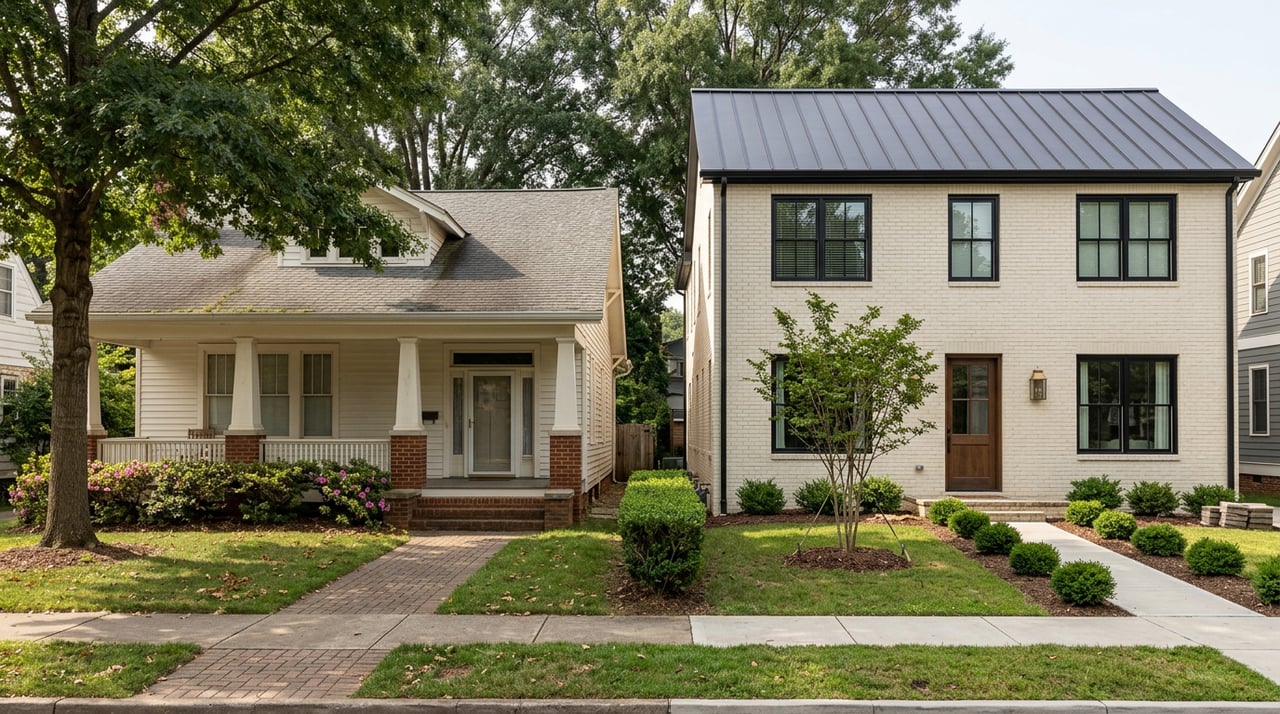
Walk two blocks off 12th Avenue South and you can find a 1920s Craftsman bungalow, original windows, original floors, sitting two doors down from a 2022 rebuild with ten-foot ceilings and a tankless water heater. List them both today and they can land within a few percentage points of each other in price. That should not make sense. One is a hundred years old. The other has never been lived in. The condition, the systems, the square footage, none of it lines up. And yet the numbers do.
The reason isn't mysterious once you see it, but almost nobody buying in 12 South is told to look for it: on a growing share of blocks, the price of a house here has stopped tracking what's inside it and started tracking what's legally allowed to replace it.
Zoom out to the ZIP code level and the pattern gets easier to see. Over the twelve months ending in June 2026, Metro Nashville's building permit data for 37204, the zip that contains 12 South, recorded 344 issued permits worth roughly $157.2 million in reported construction. Inside that total:
Put the first two numbers next to each other and the math gets interesting. For roughly every three new single-family homes permitted in the zip this past year, two lots were cleared first. That ratio doesn't happen in a neighborhood where people are mostly buying old houses to live in them. It happens in a neighborhood where the land under the house has become worth more, on a per-square-foot basis, than the house standing on it.
Worth noting: 37204 is broader than 12 South proper, so this data reflects the wider zip, not the half-mile commercial corridor alone. But the residential blocks that ring 12th Avenue South are exactly the kind of tight, walkable, older-stock lots where this kind of math tends to concentrate first, because the land is scarce and the zoning envelope allows a bigger house than the one already sitting there.
You don't have to take the permit data on faith. The closed sales back it up. Over the trailing 12 months through June 2026, 12 South recorded 105 closed sales with a median price of $1,380,000, a 12-day median days on market, and a 97.6 percent median sale-to-list ratio. Fast, close to asking, consistently. That's not a market where buyers are agonizing over crown molding. That's a market pricing something more predictable than a house.
Two recent sales at the top of the range make the point cleanly:
| Address | Built | Square Feet | Sale Price |
|---|---|---|---|
| Sweetbriar Avenue | 1930 | 6,453 | $5,064,050 |
| Clayton Avenue | 2025 (new build) | Not disclosed | $3,949,451 |
A fully renovated 1930s home on a large lot and a brand-new ground-up build closed within about a million dollars of each other. That gap is smaller than the difference in age, systems, and construction risk would suggest it should be. Original Craftsman bungalows in smaller footprints still start around $600,000 to $800,000, and new construction or substantial renovations run $1.2 million to $2 million and up. But those ranges overlap heavily block by block, which is exactly the tell. When an untouched original and a fresh rebuild can share a price bracket on the same street, the market isn't valuing the structure. It's valuing the dirt and the envelope allowed on it, then treating whatever's built on top as a variable, not the main event.
This is the part that changes how you should read a 12 South listing. In most housing markets, an older home with original systems trades at a discount to a comparable new build, because a buyer has to budget for the roof, the wiring, the HVAC, eventually the foundation. Here, that discount compresses or disappears on any lot where a builder could plausibly tear down and rebuild to the maximum allowed footprint. The buyer competing for that bungalow isn't only weighing "how much work does this house need." They're weighing "what could legally replace it, and what would that be worth."
That's also why the fast closing times and tight sale-to-list ratios make sense. Land value is a more knowable number than the idiosyncratic condition of a hundred-year-old house. Builders and investors can model it quickly, which means offers come in fast and close to ask, because the calculation underneath the offer is closer to arithmetic than to appraisal.
You don't have to guess what a neighborhood looks like when it tries to interrupt this pattern. Battlemont, the neighborhood immediately south of 12 South across I-440, tucked between Franklin Pike, Woodmont Boulevard, and Belmont Boulevard, has been slowly remade with large new homes over the past decade, and its residents are actively organizing against it.
After reviving its neighborhood association during the COVID era, Battlemont residents pushed back harder in 2022, when a group of neighbors on Sutton Hill Road challenged a builder over a legal but out-of-step setback on a new home. As of earlier this year, that effort has grown into a push to secure a conservation overlay from Metro's Planning Department, a zoning tool that would require new construction and major renovations in the district to be reviewed against design guidelines rather than built purely to the maximum allowed envelope. Green Hills district councilmember Jeff Preptit, whose district includes Battlemont, is separately guiding a similar conservation-overlay push for a few hundred homes near Lipscomb University. If Battlemont succeeds, it joins a small and expensive club of Nashville neighborhoods, including Whitland, Richland, and Lockeland Springs, where this same land-value math has already been slowed down by design review.
Nothing in the public record shows 12 South's own residential side streets carrying that same protection. The neighborhood's named design designation, the 12th Avenue South DNDP, is built around the corridor itself. That's the asymmetry worth understanding before you fall for a listing photo: a neighbor a few blocks south is actively working to take the teardown math off the table. In 12 South, for now, that math still runs unchecked.
If you're deciding between an original 12 South bungalow and new construction, the condition of the house you're touring tells you less than the lot it sits on. Ask what the zoning envelope actually allows, not just what's currently built. A well-kept original home on a lot that could support a much larger footprint is, in the market's eyes, closer to a teardown candidate than a finished product, whatever its current condition suggests. That changes how you should think about renovation math too: if the land underneath your future purchase is already priced near its rebuild ceiling, a light cosmetic renovation may not move your resale number much, because you're not the one being paid for the upgrade. The next buyer's builder is.
This is the exact intersection where design and development experience earns its keep, reading a lot's real potential rather than just its current finishes, and knowing which blocks are still priced on livability versus which have already shifted to land value. That's the lens worth having before you write an offer in this neighborhood, whether you're chasing bungalow character or evaluating a rebuild yourself.
Does 12 South itself have a conservation overlay? Not on its residential streets. The neighborhood's design protections cover the 12th Avenue South commercial corridor, not the surrounding blocks where most of the teardown and rebuild activity is happening.
Does buying an original bungalow guarantee I can renovate it instead of it becoming a teardown someday? No. Ownership doesn't change the zoning envelope. What you can build, or what a future buyer's builder could build, is set by the lot and the base district rules, not by what currently stands on it.
How can I tell if a specific listing is priced on land value or house value? Compare the asking price to recent land-driven sales on the same block, not just the ZIP median, and look at whether nearby lots have seen recent demolition or new-build permits. A cluster of recent teardown activity on a street is a strong signal that the next sale on that block will be priced the same way.
If you're weighing an original 12 South bungalow against a new build, or trying to figure out what a specific lot is actually worth once you account for what could replace it, Beth Dodd works both sides of that math daily, as a REALTOR® and as a design-build developer. Request a free valuation and consultation before you make an offer on either kind of house.
A Proven Dealmaker Combining Design Expertise, Meticulous Execution, Financial Insight and Trusted Partnership Throughout Greater Nashville.